Community Resources
Over the last 7 years, the MCC has generated and phenotyped 4 P. falciparum genetic crosses, all with multiple biological replicates, resulting in hundreds of unique recombinant progeny. These crosses have been used for identifying genetic determinants of resistance to frontline antimalarial drugs, nutritional requirements and metabolism, parasite fitness, single-cell transcriptomics, and more.
The generation of these crosses relies on our novel human hepatocyte-liver chimeric mouse model (the FRG huHep mouse). Anopheles stephensi mosquitoes are fed on P. falciparium cultures adjusted to contain equal portions of gametocytes from each parental parasite. Recombinant sporozoites are injected into the FRG huHep mice 6 days after inoculation in the mosquito. During the transition from liver to blood stages, the mice are injected with human red blood cells before being exsanguinated to recover bulk pool of recombinant parasites. Individual parasites are isolated through limited dilution cloning and genotyped via Illumina sequencing.
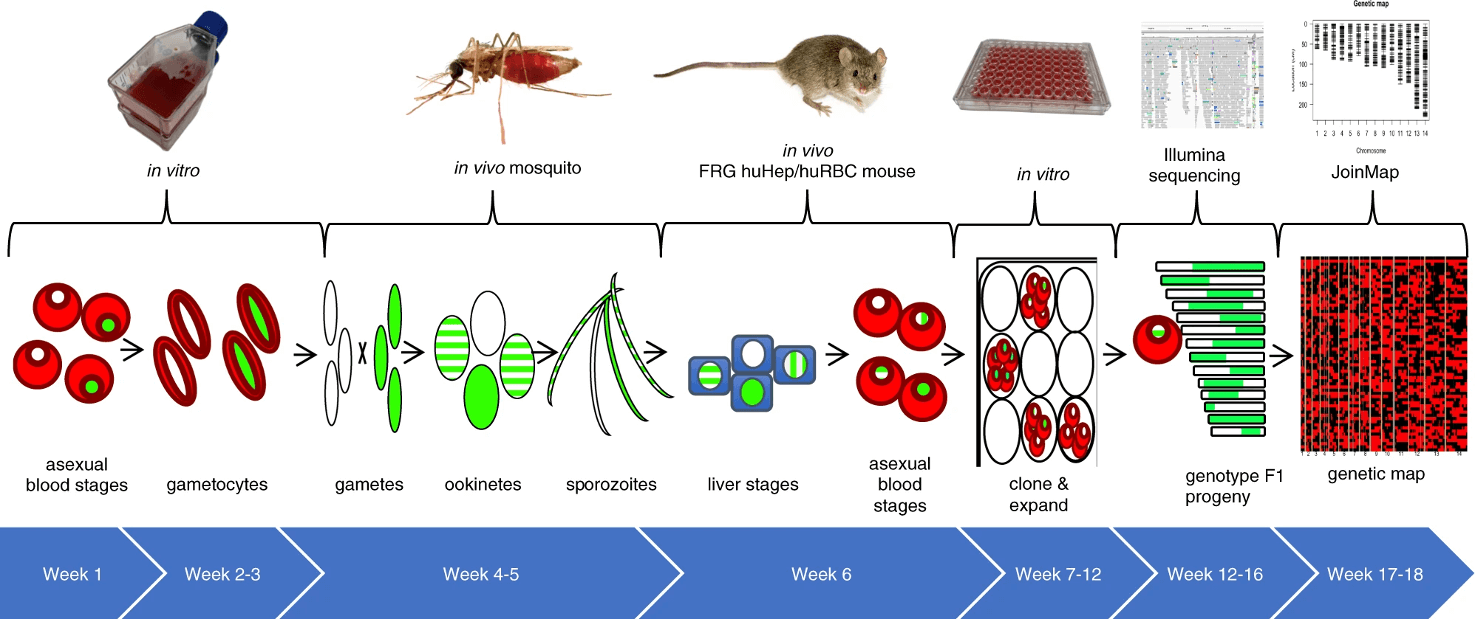
Over the last 7 years, the MCC has generated and phenotyped 4 P. faciparum genetic crosses, all with multiple biological replicates, resulting in hundreds of unique recombinant progeny. Sequence data for these crosses can be found on the NIH sequence read archive (SRA) website (see pages of individual crosses for accession numbers).
| Parental Strains | Number of Unique Recombinants | MMC Experiments | |
|---|---|---|---|
| NF54 (Africa) Drug Sensitive |
NHP4026 (Asia) CQ Resistant |
270 | Lifecycle, drug, and nutrient bulk segregant analysis; organelle inheritance, outcrossing, drug and fitness phenotyping |
| MKK2835 (Asia) ART-S; CQ-R |
NHP1337 (Asia) ART-R; CQ-R |
60 | Lifecycle and drug bulk segregant analysis; drug phenotyping |
| Mal31 (Africa) Drug Sensitive |
KH004 (Asia) ART-R; CQ-R; PPQ-R |
104 | Drug bulk segregant analysis; drug and fitness phenotyping |
| NF54 (Africa) Drug Sensitive |
NHP1337 (Asia) ART-R; CQ-R |
Bulk pool only | Drug bulk segregant analysis |
| NF54 (Africa) Drug Sensitive |
7G8 (South America) CQ-R |
Recombination rate. Mouse model proof of concept | |
| NF54 (Africa) Drug Sensitive |
GB4 (Africa) CQ-R |
Recombination rate. Mouse model proof of concept | |
To inquire about progeny from any of our genetic crosses, please email mcc@nd.edu