AAT1
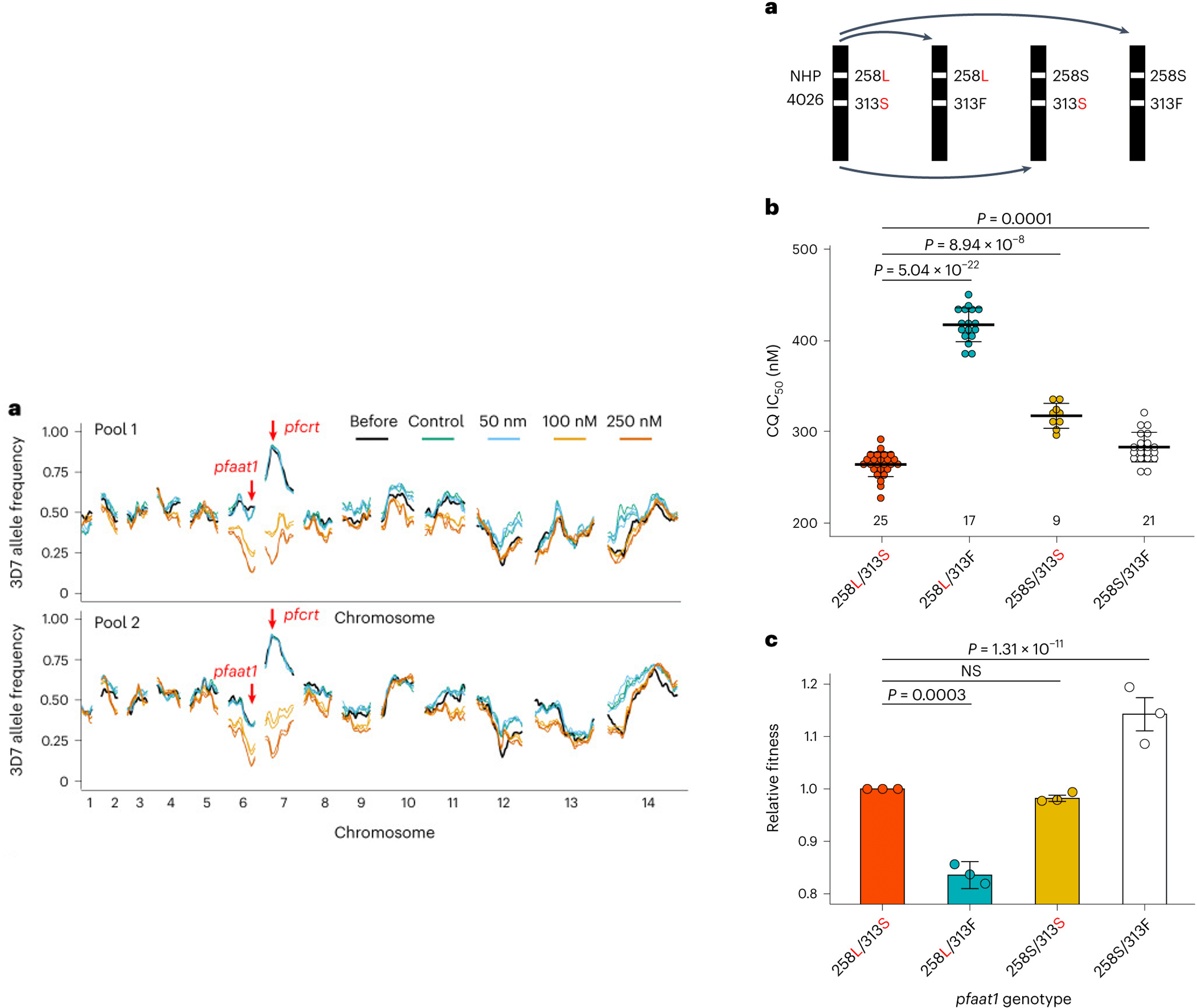
Since the early days of studying chloroquine resistance, it was assumed that a mutations to a single gene, pfcrt, were responsible for conferring resistance to chloroquine. However, through a combination of bulk segregant analysis (NF54xNHP4026 cross) and long-term population studies from The Gambia, the MCC was the first to identify a second gene, pfaat1, which was co-selected with pfcrt during the emergence of chloroquine resistance. We have found that genetic variation in this gene leads to significant shifts in resistance levels to chloroquine as well as other select frontline antimalarials. In addition to the progeny from the NF54xNHP4026 cross, we generated 3 CRISPR/Cas9 edited parasites which represent 3 of the most prevalent PfAAT1 genotypes found globally.
Publications
Amambua-Ngwa A, Button-Simons KA, Li X, Kumar S, Brenneman KV, Ferrari M, Checkley LA, Haile MT, Shoue DA, McDew-White M, Tindall SM, Reyes A, Delgado E, Dalhoff H, Larbalestier JK, Amato R, Pearson RD, Taylor AB, Nosten FH, D'Alessandro U, Kwiatkowski D, Cheeseman IH, Kappe SHI, Avery SV, Conway DJ, Vaughan AM, Ferdig MT, Anderson TJC. Chloroquine resistance evolution in Plasmodium falciparum is mediated by the putative amino acid transporter AAT1. Nat Microbiol. 2023 Jul;8(7):1213-1226. doi: 10.1038/s41564-023-01377-z. Epub 2023 May 11. PMID: 37169919; PMCID: PMC10322710.