Artemisinin Resistance
Resistance to artemisinin has been a core focus of the MCC since its inception. Our various crosses have sought to understand delayed patient clearance in the absence of kelch13 mutations (NHP4026xNF54), kelch13-driven ART resistance in allopatric (NF54xNHP1337) and sympatric (NHP1337xMKK2835) manners, and complete artemisinin combination therapy (ACT) resistance (KH004xMal31). During this second funding period of the MCC, our primary focus is using recently isolated African clinical samples as parents for our next crosses. Due to the differences in genetic structure between African and Southeast Asian parasites, these new crosses between two African parasites will identify the genetic factors underlying artemisinin tolerance in Africa as well as various non-C580Y kelch13 mutations that are present in Africa.
In addition to understanding the genetic architecture which supports the emergence of artemisinin resistance, we have also expanded on the traditional Ring-stage Survival Assay (RSA) for in vitro determination of artemisinin resistance. Our new Extended Recovery Ring-stage Survival Assay (eRRSA) not only measures parasite response to artemisinin exposure, but also quantifies how well drug-sensitive parasites recover from this strong drug exposure. Compared to traditional RSA methods which relies on microscopy, the eRRSA determines parasite survival based on difference in DNA abundance, measured via targeted qPCR, between treated and untreated samples. We have recently further modified this assay to be able to perform high throughput ex vivo eRRSA using dried blood spots from infected patients.
Publications
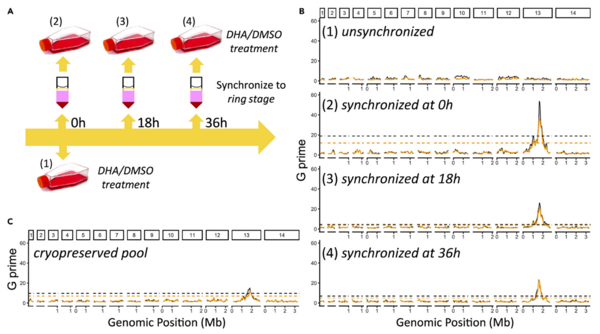
Brenneman KV, Li X, Kumar S, Delgado E, Checkley LA, Shoue DA, Reyes A, Abatiyow BA, Haile MT, Tripura R, Peto T, Lek D, Button-Simons KA, Kappe SHI, Dhorda M, Nosten F, Nkhoma SC, Cheeseman IH, Vaughan AM, Ferdig MT, Anderson TJC. Optimizing bulk segregant analysis of drug resistance using Plasmodium falciparum genetic crosses conducted in humanized mice. iScience. 2022 Mar 16;25(4):104095. doi: 10.1016/j.isci.2022.104095. PMID: 35372813; PMCID: PMC8971943.
Davis SZ, Singh PP, Vendrely KM, Shoue DA, Checkley LA, McDew-White M, Button-Simons KA, Cassady Z, Sievert MAC, Foster GJ, Nosten FH, Anderson TJC, Ferdig MT. The extended recovery ring-stage survival assay provides a superior association with patient clearance half-life and increases throughput. Malar J. 2020 Jan 31;19(1):54. doi: 10.1186/s12936-020-3139-6. PMID: 32005233; PMCID: PMC6995136.