Genetic Crosses
Navigate to genetic cross:
NF54×NHP4026
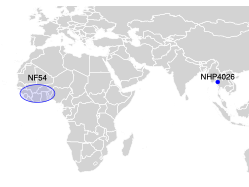
One of our most notable and well studied crosses, we crossed the CQ-R and slow patient clearing parasite (NHP4026) which was isolated from the Thai-Myanmar with the well characterized drug-sensitive laboratory strain (NF57). This cross generated a total of 270 progeny, of which 109 were unique recombinants. The use of bulk segregant analysis (BSA) on this cross led to the identification of pfaat1 and its epistatic interaction with pfcrt as well as its role in enhancing chloroquine resistance.
Notable phenotypes and genotypes
NF54: drug sensitive; WT pfcrt, pfkelch13, and pfaat1; high fitness
NHP4026: CQ-R (Dd2-like pfcrt and S258L+F313S pfaat1); slow clearing to ACT (WT pfkelch13); high fitness
See sequence repository for all progeny and parents
Publications
Amambua-Ngwa A, Button-Simons KA, Li X, Kumar S, Brenneman KV, Ferrari M, Checkley LA, Haile MT, Shoue DA, McDew-White M, Tindall SM, Reyes A, Delgado E, Dalhoff H, Larbalestier JK, Amato R, Pearson RD, Taylor AB, Nosten FH, D'Alessandro U, Kwiatkowski D, Cheeseman IH, Kappe SHI, Avery SV, Conway DJ, Vaughan AM, Ferdig MT, Anderson TJC. Chloroquine resistance evolution in Plasmodium falciparum is mediated by the putative amino acid transporter AAT1. Nat Microbiol. 2023 Jul;8(7):1213-1226. doi: 10.1038/s41564-023-01377-z. Epub 2023 May 11. PMID: 37169919; PMCID: PMC10322710.
Kumar S, Li X, McDew-White M, Reyes A, Delgado E, Sayeed A, Haile MT, Abatiyow BA, Kennedy SY, Camargo N, Checkley LA, Brenneman KV, Button-Simons KA, Duraisingh MT, Cheeseman IH, Kappe SHI, Nosten F, Ferdig MT, Vaughan AM, Anderson TJC. A Malaria Parasite Cross Reveals Genetic Determinants of Plasmodium falciparum Growth in Different Culture Media. Front Cell Infect Microbiol. 2022 May 30;12:878496. doi: 10.3389/fcimb.2022.878496. PMID: 35711667; PMCID: PMC9197316.
Button-Simons KA, Kumar S, Carmago N, Haile MT, Jett C, Checkley LA, Kennedy SY, Pinapati RS, Shoue DA, McDew-White M, Li X, Nosten FH, Kappe SH, Anderson TJC, Romero-Severson J, Ferdig MT, Emrich SJ, Vaughan AM, Cheeseman IH. The power and promise of genetic mapping from Plasmodium falciparum crosses utilizing human liver-chimeric mice. Commun Biol. 2021 Jun 14;4(1):734. doi: 10.1038/s42003-021-02210-1. PMID: 34127785; PMCID: PMC8203791.

Mal31×KH004
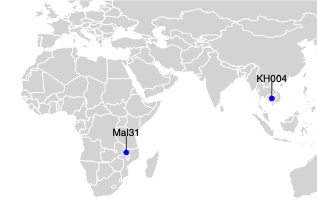
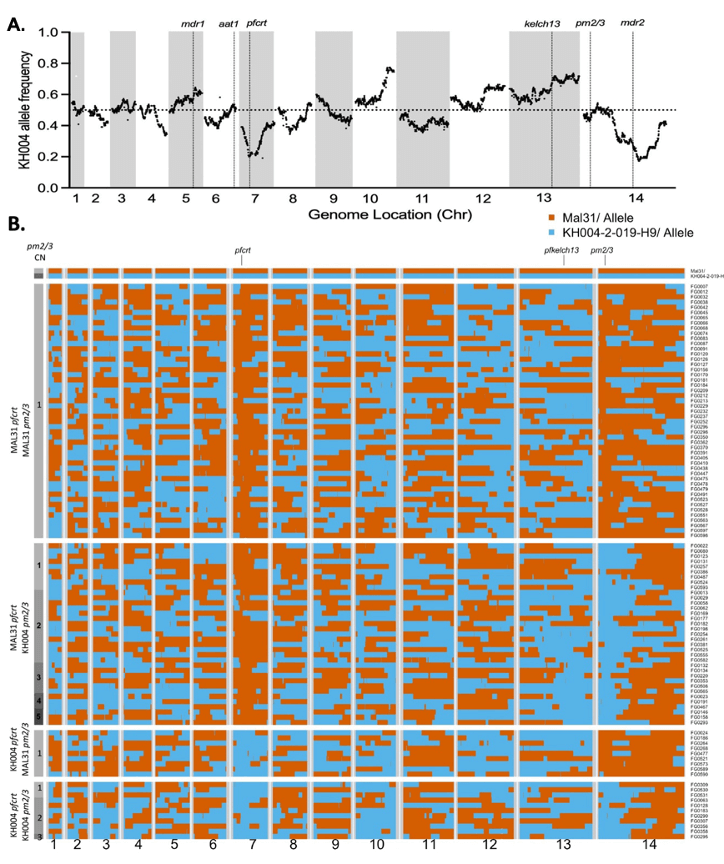
This cross was generated to understand genetic determinants which preserve parasite fitness in multidrug-resistant parasites. KH004 is a 2016 Cambodian isolate of the KEL1/PLA1 lineage of parasites. It is resistant to CQ, ART, and PPQ while retaining a moderate level of fitness. Mal31 is a 2016 drug-sensitive isolate from Malawi and harbors a pfcrt allele which has been naturally reverted back to WT after extensive lack of CQ pressure. This cross produced a total of 319 clonal recombinant parasites, of which 104 had unique genotypes. A unique feature of this cross is that KH004 carries 4 copies of plasmepsin II/III and progeny inherited a variety of copies ranging from 1 to 5. Additionally, KH004 has a highly novel PPQ-R pfcrt mutation (G367C) which has recently increased in prevalence in Eastern Southeast Asia.
Notable phenotypes and genotypes
Mal31: drug sensitive (WT pfcrt, pfkelch13, single copy plasmepsin II/III, S258L pfaat1); low fitness
KH004: CQ-R and PPQ-R (Dd2-like pfcrt + G367C, 4 copies plasmepsin II/III, S258L+F313S pfaat1); ART-R (C580Y pfkelch13); high fitness
See sequence repository for all progeny and parents
Project Number: PRJNA524855
Publications
Kane J, Li X, Kumar S, Button-Simons KA, Vendrely Brenneman KM, Dahlhoff H, Sievert MAC, Checkley LA, Shoue DA, Singh PP, Abatiyow BA, Haile MT, Nair S, Reyes A, Tripura R, Peto TJ, Lek D, Mukherjee A,Kappe SHI, Dhorda M, Nkhoma SC, Cheeseman IH,Vaughan AM, Anderson TJC, Ferdig MT.2024. A Plasmodium falciparum genetic cross reveals the contributions of pfcrt and plasmepsin II/III to piperaquine drug resistance. mBio15:e00805-24.https://doi.org/10.1128/mbio.00805-24
Brenneman KV, Li X, Kumar S, Delgado E, Checkley LA, Shoue DA, Reyes A, Abatiyow BA, Haile MT, Tripura R, Peto T, Lek D, Button-Simons KA, Kappe SHI, Dhorda M, Nosten F, Nkhoma SC, Cheeseman IH, Vaughan AM, Ferdig MT, Anderson TJC. Optimizing bulk segregant analysis of drug resistance using Plasmodium falciparum genetic crosses conducted in humanized mice. iScience. 2022 Mar 16;25(4):104095. doi: 10.1016/j.isci.2022.104095. PMID: 35372813; PMCID: PMC8971943.
NF54×NHP1337
Notable phenotypes and genotypes
NF54: drug sensitive; WT pfcrt, pfkelch13, and pfaat1; high fitness
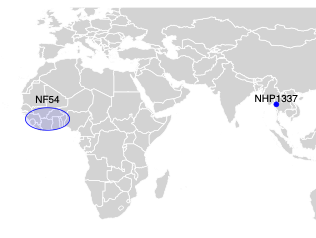
NHP1337: CQ-R (Dd2 pfcrt, S258L+F313S pfaat1); ART-R (C580Y pfkelch13); low-moderate fitness
See to sequence repository for BSA
Project Number: PRJNA524855
Publications
Button-Simons KA, Kumar S, Carmago N, Haile MT, Jett C, Checkley LA, Kennedy SY, Pinapati RS, Shoue DA, McDew-White M, Li X, Nosten FH, Kappe SH, Anderson TJC, Romero-Severson J, Ferdig MT, Emrich SJ, Vaughan AM, Cheeseman IH. The power and promise of genetic mapping from Plasmodium falciparum crosses utilizing human liver-chimeric mice. Commun Biol. 2021 Jun 14;4(1):734. doi: 10.1038/s42003-021-02210-1. PMID: 34127785; PMCID: PMC8203791.
Brenneman KV, Li X, Kumar S, Delgado E, Checkley LA, Shoue DA, Reyes A, Abatiyow BA, Haile MT, Tripura R, Peto T, Lek D, Button-Simons KA, Kappe SHI, Dhorda M, Nosten F, Nkhoma SC, Cheeseman IH, Vaughan AM, Ferdig MT, Anderson TJC. Optimizing bulk segregant analysis of drug resistance using Plasmodium falciparum genetic crosses conducted in humanized mice. iScience. 2022 Mar 16;25(4):104095. doi: 10.1016/j.isci.2022.104095. PMID: 35372813; PMCID: PMC8971943.

MKK2835×NHP1337
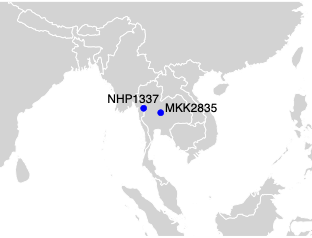
This sympatric cross utilizes two newly cloned clinical isolates (MKK2835 and NHP1337) from the Thai–Myanmar border. These parasites were respectively isolated before (2003) and after (2013) the emergence of artemisinin resistance in the region. This cross yielded 60 clonal unique recombinant progeny.
Notable phenotypes and genotypes
MKK2835: CQ-R (Dd2 pfcrt, F313S+K541N pfaat1); moderate fitness
NHP1337: CQ-R (Dd2 pfcrt, S258L+F313S pfaat1); ART-R (C580Y pfkelch13); low-moderate fitness
Publications
Button-Simons KA, Kumar S, Carmago N, Haile MT, Jett C, Checkley LA, Kennedy SY, Pinapati RS, Shoue DA, McDew-White M, Li X, Nosten FH, Kappe SH, Anderson TJC, Romero-Severson J, Ferdig MT, Emrich SJ, Vaughan AM, Cheeseman IH. The power and promise of genetic mapping from Plasmodium falciparum crosses utilizing human liver-chimeric mice. Commun Biol. 2021 Jun 14;4(1):734. doi: 10.1038/s42003-021-02210-1. PMID: 34127785; PMCID: PMC8203791.
Li X, Kumar S, McDew-White M, Haile M, Cheeseman IH, Emrich S, Button-Simons K, Nosten F, Kappe SHI, Ferdig MT, Anderson TJC, Vaughan AM. Genetic mapping of fitness determinants across the malaria parasite Plasmodium falciparum life cycle. PLoS Genet. 2019 Oct 14;15(10):e1008453. doi: 10.1371/journal.pgen.1008453. PMID: 31609965; PMCID: PMC6821138.
Kumar S, Li X, McDew-White M, Reyes A, Delgado E, Sayeed A, Haile MT, Abatiyow BA, Kennedy SY, Camargo N, Checkley LA, Brenneman KV, Button-Simons KA, Duraisingh MT, Cheeseman IH, Kappe SHI, Nosten F, Ferdig MT, Vaughan AM, Anderson TJC. A Malaria Parasite Cross Reveals Genetic Determinants of Plasmodium falciparum Growth in Different Culture Media. Front Cell Infect Microbiol. 2022 May 30;12:878496. doi: 10.3389/fcimb.2022.878496. PMID: 35711667; PMCID: PMC9197316.